Why Most Content Fails (And How Persona Mapping Fixes It)
Why Most Content Fails (And How Persona Mapping Fixes It)
Why Most Content Fails (And How Persona Mapping Fixes It)
Why Most Content Fails (And How Persona Mapping Fixes It)

Before we write a single word for any client, we don’t start with hooks, formats, or posting schedules.
We start with persona mapping.
Because most content doesn’t fail due to lack of effort. It fails due to lack of clarity.
The Real Problem With Most Content
Most professionals think they know their audience.
They write for:
“Founders”
“Leaders”
“Decision makers”
But no one wakes up thinking like that.
They wake up thinking:
“I’m behind on this quarter”
“This initiative isn’t working”
“I don’t know how to fix this—and I can’t say it out loud”
If your content doesn’t speak to that reality, it gets ignored.
Not because it’s bad. Because it’s not specific enough.
What Persona Mapping Actually Means
Persona mapping is the process of defining one specific person your content is meant to reach.
Not a segment. Not a title. A person.
Someone in a real situation, under real pressure, right now.
Because content doesn’t land on audiences.
It lands on individuals.
The 5 Questions That Shape Everything
Before we begin, we ask every client five questions:
1. Who exactly are they? Not just their title—what’s their seniority, and who do they answer to?
2. What pressure are they under this quarter? A missed target, a failing project, a mandate they didn’t ask for.
3. Are they problem-aware? Do they know what’s wrong—or are they still trying to figure it out?
4. What are they searching for privately (at 11pm)? What they’d never say in a meeting is what they’ll search online.
5. What kind of proof makes them trust someone new? Not claims—signals. Case studies, lived experience, or clarity of thought.
What Changes When You Get This Right
When you can answer these clearly, something shifts.
You stop writing content.
You start writing something that feels like:
“This person understands exactly what I’m going through.”
And that’s when people respond.
The Insight Most People Miss
Your expertise isn’t the issue.
The problem is not knowing exactly who you’re speaking to.
When that becomes clear:
Your ideas get sharper
Your messaging gets simpler
Your content starts working
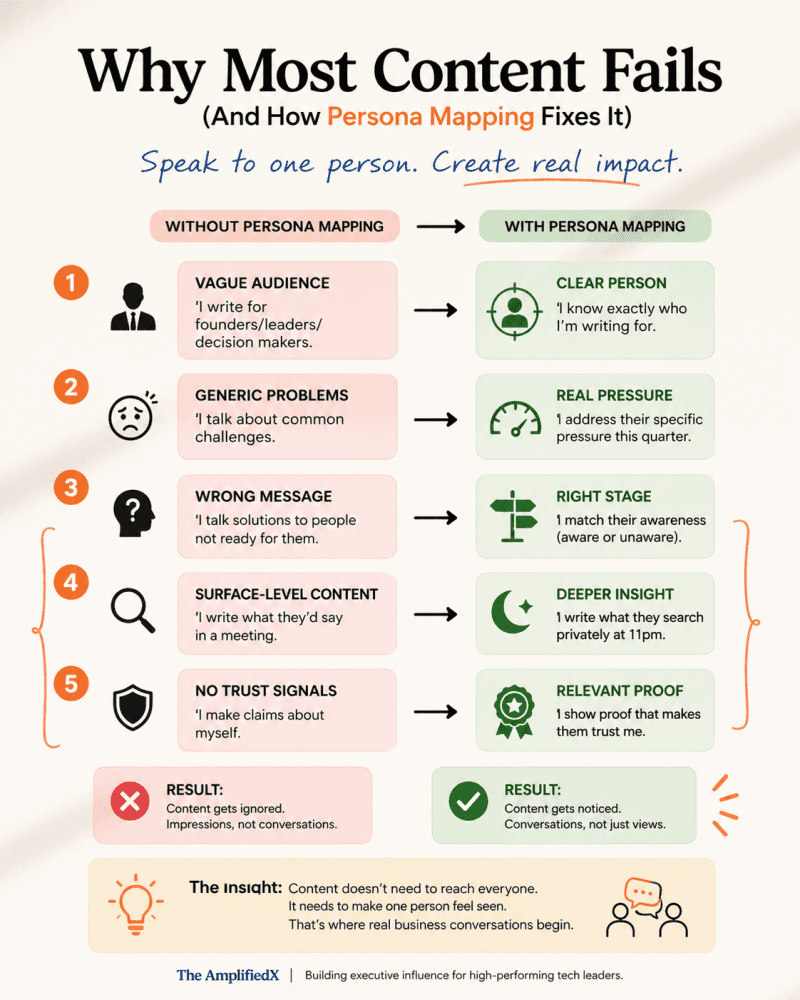
Final Thought
Content doesn’t need to reach everyone.
It needs to resonate deeply with one person.
Because when someone feels seen, they stop scrolling. They start paying attention. And that’s where real business conversations begin.
The AmplifiedX — building executive influence for high-performing tech leaders.
Before we write a single word for any client, we don’t start with hooks, formats, or posting schedules.
We start with persona mapping.
Because most content doesn’t fail due to lack of effort. It fails due to lack of clarity.
The Real Problem With Most Content
Most professionals think they know their audience.
They write for:
“Founders”
“Leaders”
“Decision makers”
But no one wakes up thinking like that.
They wake up thinking:
“I’m behind on this quarter”
“This initiative isn’t working”
“I don’t know how to fix this—and I can’t say it out loud”
If your content doesn’t speak to that reality, it gets ignored.
Not because it’s bad. Because it’s not specific enough.
What Persona Mapping Actually Means
Persona mapping is the process of defining one specific person your content is meant to reach.
Not a segment. Not a title. A person.
Someone in a real situation, under real pressure, right now.
Because content doesn’t land on audiences.
It lands on individuals.
The 5 Questions That Shape Everything
Before we begin, we ask every client five questions:
1. Who exactly are they? Not just their title—what’s their seniority, and who do they answer to?
2. What pressure are they under this quarter? A missed target, a failing project, a mandate they didn’t ask for.
3. Are they problem-aware? Do they know what’s wrong—or are they still trying to figure it out?
4. What are they searching for privately (at 11pm)? What they’d never say in a meeting is what they’ll search online.
5. What kind of proof makes them trust someone new? Not claims—signals. Case studies, lived experience, or clarity of thought.
What Changes When You Get This Right
When you can answer these clearly, something shifts.
You stop writing content.
You start writing something that feels like:
“This person understands exactly what I’m going through.”
And that’s when people respond.
The Insight Most People Miss
Your expertise isn’t the issue.
The problem is not knowing exactly who you’re speaking to.
When that becomes clear:
Your ideas get sharper
Your messaging gets simpler
Your content starts working
Final Thought
Content doesn’t need to reach everyone.
It needs to resonate deeply with one person.
Because when someone feels seen, they stop scrolling. They start paying attention. And that’s where real business conversations begin.
The AmplifiedX — building executive influence for high-performing tech leaders.

© 2026 AmplifiedX. All rights reserved. Privacy Policy
© 2022 AmplifiedX. All rights reserved. Privacy Policy